
 SEO Services
  Request a Quote
Reposition AE


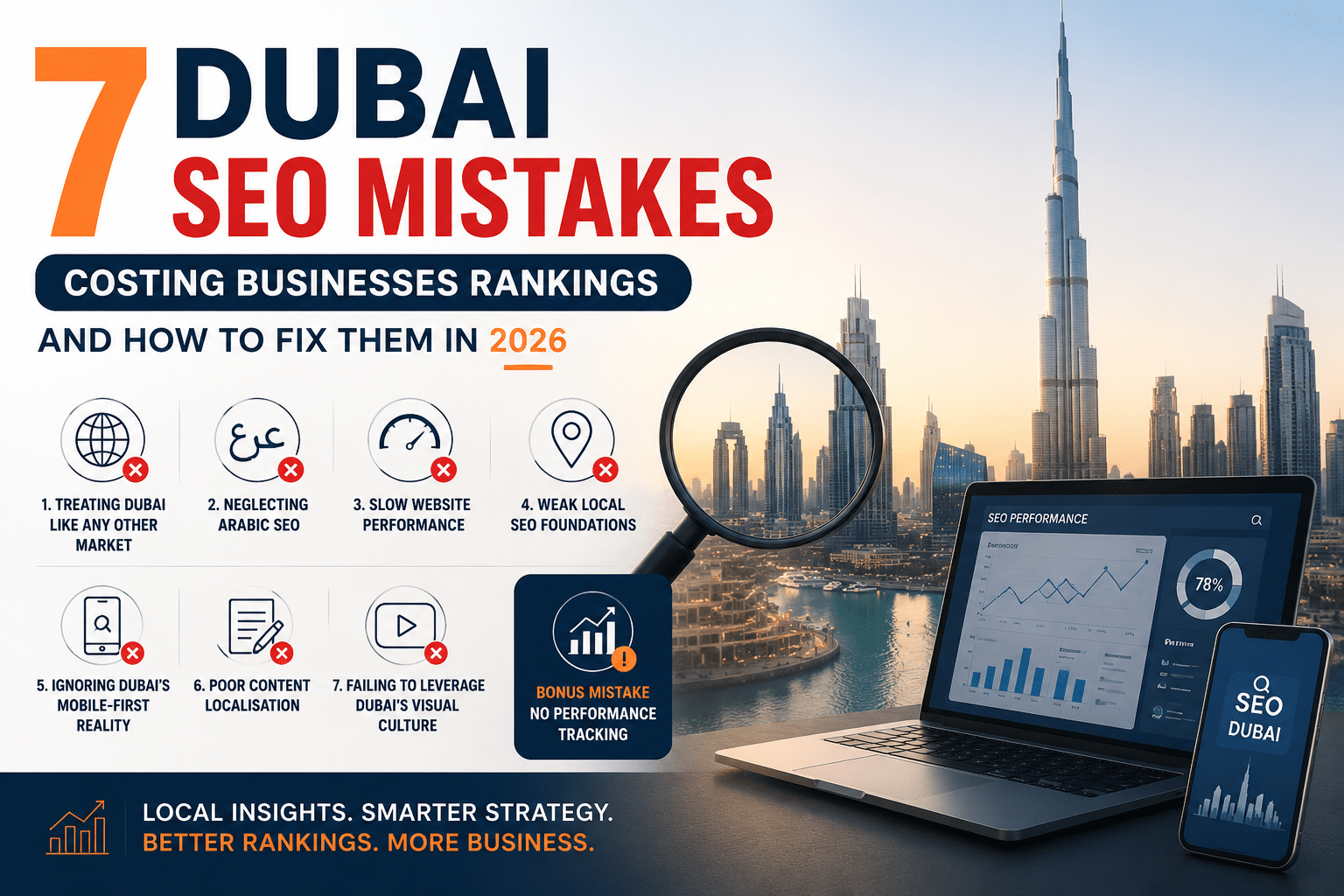
Dubai’s digital marketplace is among the world’s most competitive, yet many businesses undermine their search visibility through recurring, avoidable errors. In 2026, with 98% mobile penetration and a population that is 90% expatriate, generic global SEO strategies simply don’t cut it. The businesses ranking on page one in Dubai are the ones that have localized their approach: they speak Arabic, load fast on mobile, show up in neighborhood searches, and produce the kind of visual content this city actually consumes.
Below are the seven most damaging SEO mistakes Dubai businesses make, and exactly how to fix them.
Many businesses arrive in Dubai and simply copy-paste their existing global SEO strategy. Same keywords, same content, same site structure — just a new city name dropped in here and there. This approach is one of the fastest ways to burn your marketing budget and remain invisible online.
Dubai has search behaviors unlike any other city on earth. Residents search in both Arabic and English, often within the same session. They search by neighbourhood DIFC, JBR, Arabian Ranches, Business Bay not just by city. And they do all of this on their phones. A strategy built for London or New York ignores all of this context.
Optimise for Dubai’s dominant devices: iPhone 15 Pro Max and Samsung Galaxy S24 Ultra
The vast majority of Dubai business websites are English-only a critical blind spot in a city where 60% of users actively prefer searching in Arabic.
Arabic search volume is surging. Searches for “تسويق رقمي” (digital marketing) grew by 140% in Dubai last year alone. Businesses without Arabic content are effectively invisible to more than half their potential audience and that gap is widening every year.
Add Arabic schema markup to enable rich snippets in Arabic search results
Bloated websites with uncompressed images, heavy scripts, and servers located overseas are painfully slow for Dubai users and Google penalizes them for it.
Dubai’s average page load expectation sits at 1.3 seconds. If your site takes longer than 3 seconds to load, 53% of visitors have already left. In a mobile-first market where users are accustomed to ultra-fast connectivity, slow load times are brand-damaging and algorithmically penalized.
Implement Accelerated Mobile Pages (AMP) for high-traffic landing pages
Inconsistent business information scattered across directories or no local listings at all is one of the most common and most fixable SEO failures in Dubai.
78% of “near me” searches in Dubai result in an in-store visit. If your Name, Address, and Phone number (NAP) data is inconsistent or missing from key platforms, Google treats your business as unreliable and suppresses it in local results. In a city where physical footfall is still enormously valuable, this is a direct hit to revenue.
Create dedicated location pages for each area you serve, not just one generic “Contact Us” page
Still designing and testing primarily for desktop in a market where nearly every single person is on their phone.
With 98% mobile penetration, Dubai is one of the most mobile-saturated markets on earth. Google’s mobile-first indexing means your mobile experience is your SEO. Clunky navigation, tiny tap targets, and slow mobile speeds push sites down the rankings regardless of how polished the desktop version is.
Optimize for voice search in both Arabic and English, as smart speaker and voice assistant usage continues to climb across the UAE
Repurposing global blog posts and marketing copy by simply swapping city names without any genuine Dubai-specific insight or local relevance.
Dubai searchers want hyper-local answers. They’re searching for “Best schools in Arabian Ranches 2026” or “PRO services for Dubai free zone companies,” not generic guides written for a global audience. Google increasingly rewards genuine expertise and local depth thin, templated content simply doesn’t rank.
Feature genuine case studies and testimonials from Dubai-based clients to build trust and topical authority in the local market
Running text-heavy websites in a city that consumes three times more video content than the global average and expects a premium visual experience at every touchpoint.
Dubai is a city built on spectacle. From luxury real estate to high-end dining, the visual presentation is part of the product. Properties listed with 360° virtual tours receive 40% more leads than those without. Brands that invest in video and visual content build stronger engagement signals, which Google interprets as quality.
Create Instagram-optimised visual assets for every key page, product, or service social sharing and visual discoverability are part of the SEO ecosystem in Dubai
The deadliest mistake of all is flying blind. Many Dubai businesses run Google Analytics but never segment it for Dubai-specific insights. Without the right data, you cannot know what is actually working.
At a minimum, you should be tracking:
Arabic versus English conversion rates, so you can allocate localization budget where it delivers the greatest return
If even two or three of these mistakes describe your current situation, you have a significant opportunity. Correcting them will not just lift your rankings it will improve the experience for every visitor who finds you, increase the likelihood they convert, and build a foundation for sustainable growth in one of the world’s most dynamic markets.
Begin with a full SEO audit to benchmark where you stand across all seven areas. Then build a clear, prioritized, localized roadmap. In Dubai, the businesses that win online are the ones that treat the city’s uniqueness as an advantage not an afterthought.